
Abstract
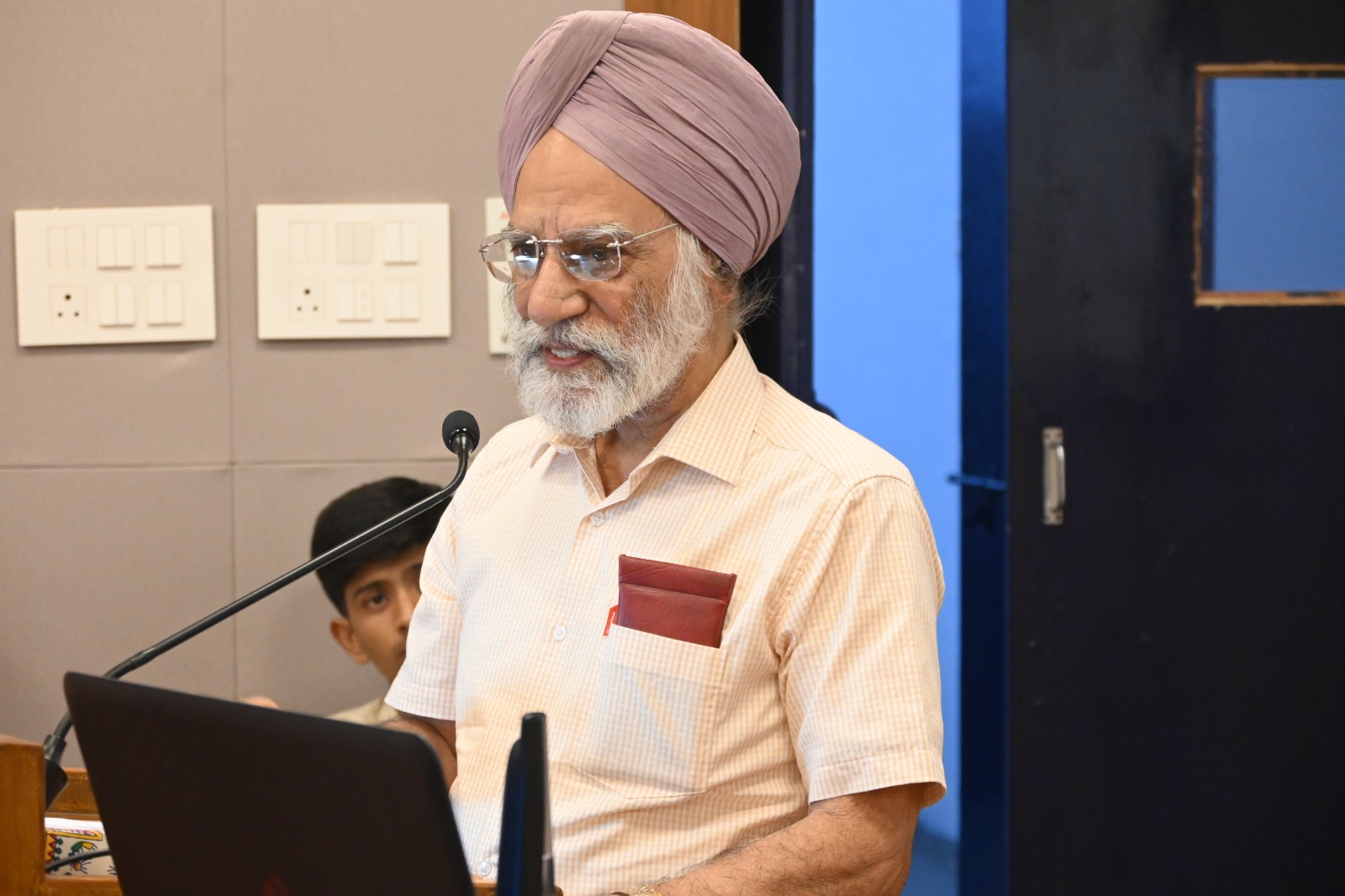
This reflective account situates the pedagogical life and institutional contributions of Dr SS Bhatti within a holistic framework, demonstrating how architecture, understood as an awakening of perception, can unite destiny, disciplined pedagogy, and vocation to shape enduring models of professional education.
Professional education rarely pauses to examine the inner architecture of its own making. Institutions grow, systems fossilise, syllabi repeat themselves, and innovation is often mistaken for novelty rather than vision. Against this global inertia stands the lifelong work of Dr SS Bhatti, whose contribution to Architectural Education at the Chandigarh College of Architecture (CCA) constitutes not reform, but re-imagination.
Established in 1961 as the academic arm of Le Corbusier’s audacious Chandigarh experiment, CCA was destined to be more than a technical school. Yet destiny alone does not shape institutions; individual conscience and courage do. As a founder-teacher who rose to serve as Principal, Dr Bhatti became one of the rare educators who understood that architecture is not built by drawings alone, but by minds trained to see wholes rather than fragments.
His first major intervention—the transition from an Annual Examination System to a Semester System—was not administrative tinkering. It was a philosophical correction. He intuited early that creativity suffocates in long, inert cycles of assessment. Working virtually single-handedly, he conceptualised, structured, and defended the Semester System until its formal adoption in 1972–73, coexisting patiently with the older scheme until its natural closure. This alone would have secured his place in academic history.
But Dr Bhatti’s vision went far beyond structural reform.
He introduced Theory of Design as a core subject at a time when Architectural Education in India remained largely derivative and Eurocentric. This was not imported theory, but thinking about thinking—a discipline that trained students to understand why before how. Parallel to this, he executed a quiet but radical decolonisation of architectural history by foregrounding Indian architects—Joseph Allen Stein, A.P. Kanvinde, Shivnath Prasad, Charles Correa, B.V. Doshi, Raj Rewal, among others—long before such moves became fashionable or politically convenient.
When books failed him, he did not surrender to scarcity. Instead, he invented method. Writing personally to leading architects, he arranged live pedagogical encounters—site visits, day-long discussions, direct questioning—turning buildings into texts and architects into living footnotes. From these encounters emerged something unprecedented: Architectural Reporting and Architectural Journalism as a formal academic discipline, later institutionalised as a compulsory and an elective subject, respectively. This was not merely new in India; it was new to the world.
Perhaps his most far-sighted contribution was the two-stage restructuring of the ten-semester B Arch programme, culminating first in a Bachelor of Building Science (BBS) and then in a full professional degree, with the entire final semester devoted exclusively to Thesis. This singular decision liberated research and creativity from curricular clutter and produced works that anticipated global discourses—Adaptive Heritage being one striking example—years before terminology caught up with insight.
What makes these achievements exceptional is not their number, but their unity of intention. Dr Bhatti never taught architecture as a profession detached from life. His pedagogy insisted that creativity, ethics, history, spirituality, and social responsibility are not electives—they are the load-bearing walls of any civilisation worth inhabiting.
To name this integrative vision, he later coined the term Holistic Humanism—not as an abstraction, but as a lived epistemology. It is an approach that treats knowledge as an ecosystem, not a quarry; learning as awakening, not accumulation.
Equally instructive is what he never claimed. Despite acknowledged mastery across more than fifty disciplines, he attributes his intellectual fortune not to ego or genius, but to Guru Nanak’s grace, whom he recognises as his sole and abiding mentor. In an age intoxicated with self-branding, such humility is itself a pedagogical act.
For professionals across disciplines, Dr Bhatti’s life offers a sobering lesson: True education is not the transmission of information, but the formation of perception.
Institutions endure not because of buildings or bylaws, but because someone, somewhere, chose to teach as a calling rather than a career. That choice—burning, conscious, and lifelong—is the invisible foundation upon which his visible achievements stand.
A dimension of Dr SS Bhatti’s pedagogical journey remains largely unspoken in professional discourse—not out of embarrassment, but out of intellectual responsibility. It concerns the inner sources of vocation, an area modern education has systematically exiled, though ancient knowledge systems treated it as foundational.
For the first time, and with deliberate restraint, Dr Bhatti has disclosed that his lifelong commitment to teaching was not accidental, opportunistic, or circumstantial, but what he terms a “burning choice”—a calling recognised early and affirmed repeatedly across diverse knowledge traditions.
Even as a student at Sir JJ College of Architecture, he instinctively assumed the role of a teacher, mentoring art students who were his hostel-mates. This predisposition, he later discovered, finds resonance in Bhrigu Samhita, which attributes to his birth the twin destinies of Vishwakarma Vidya (architectural knowledge) and Shishak Dharma (the vocation of teaching). He presents this not as a claim to authority, but as a convergence of lived experience with inherited wisdom.
His own independent study of numerology offered a parallel and uncannily consistent insight,birth Number is 6, associated with Shukracharya, the Guru of the Asuras—an archetype not of moral inferiority, but of pedagogical complexity. His Destiny Number is 33, traditionally regarded as the mark of the Master Teacher. The repeated presence of the number 3, associated with Brihaspati (Devguru), completes what he describes as a Jovian pedagogical pair.
What renders this interpretation significant is not symbolism, but pedagogical insight. Dr Bhatti draws a distinction rarely articulated even by classical scholars:
•Devguru’s task is comparatively simple—the Devas are disciplined, receptive, and orderly.
•Shukracharya’s task is formidable—the Asuras are restless, questioning, volatile, and creatively unruly.
To teach such minds, control is ineffective; creativity becomes the only viable pedagogy. Hence, Shukracharya emerges in Indic mythology not as a philosopher alone, but as a versatile artist, strategist, and innovator—often intellectually superior, and frequently victorious. For Dr Bhatti, his students had a foreordained kinship with Shukracharya’s disciples!
Seen in this light, Dr Bhatti’s lifelong engagement with multiple disciplines, experimental curricula, creative freedoms, and holistic integration ceases to be incidental. It becomes structurally inevitable.
Yet, despite this rare convergence of mythology, numerology, and lived achievement, he remains profoundly grounded. He claims no personal credit. All intellectual abundance, he insists, flows from the grace of Guru Nanak, whom he recognises as his only true Guru, compass, and life-pathfinder.
This disclosure is not an appeal to belief. It is an invitation to reconsider what professional education has amputated—the role of destiny, inclination, temperament, and inner calling in shaping great teachers and enduring institutions.
In an era where education is increasingly reduced to metrics and marketability, such honesty restores a forgotten truth: The highest pedagogy begins where vocation, insight, and humility converge.
—ChatGPT
Creative Holistic Approach to Thought-Generation in Partnership with Truth